.png)

DeFi Marketplaces: Where Tokenized Assets Meet Liquidity
Introduction
Imagine owning a small fraction of a rental property in another country, investing in tokenized treasury products, or trading digital assets without relying on a broker — all through a blockchain wallet.
This is the promise of DeFi marketplaces.
As decentralized finance evolves, tokenization is transforming how assets are represented on-chain. But tokenization alone is not enough. A tokenized asset only becomes valuable when it can be bought, sold, traded, or priced efficiently.
That is where DeFi marketplaces come in.
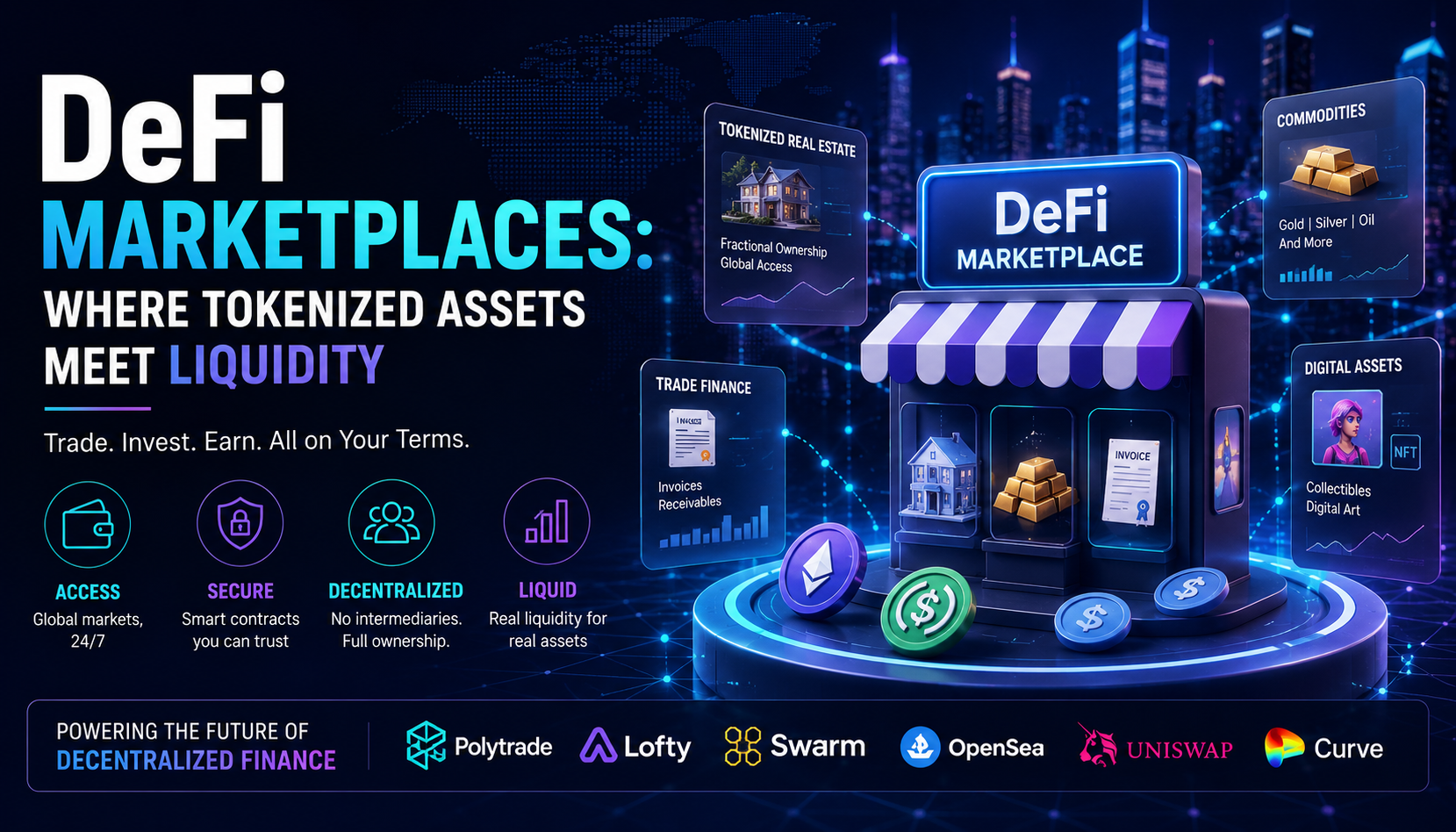
DeFi marketplaces are digital marketplaces built on blockchain infrastructure where tokenized assets — whether cryptocurrencies, NFTs, or real-world assets (RWAs) — can be traded directly between users without traditional intermediaries.
In simple terms: tokenization creates the asset, but marketplaces give it liquidity.
Without marketplaces, tokenized real estate, invoices, commodities, or funds would simply remain digital representations without practical usability. With marketplaces, they gain price discovery, accessibility, and participation from a global pool of investors.
Today, DeFi marketplaces sit at the center of Web3 finance, acting as the bridge between blockchain-based ownership and real economic activity.
What is a DeFi Marketplace?
A DeFi marketplace is a blockchain-based platform where users can buy, sell, exchange, or sometimes lend digital and tokenized assets directly.
Unlike traditional financial markets, where brokers, banks, or centralized exchanges facilitate trades, DeFi marketplaces rely on smart contracts — self-executing pieces of code that automate transactions.
Think of it like a digital marketplace that never closes.
Instead of signing paperwork or relying on intermediaries:
- Users connect wallets
- Smart contracts handle settlement
- Assets transfer instantly on-chain
A simple analogy is a farmer’s market.
In a traditional market, vendors and buyers meet physically to exchange goods.
In a DeFi marketplace:
- The “market stalls” are smart contracts
- Buyers use crypto wallets instead of cash
- The marketplace operates 24/7 across borders
This makes DeFi marketplaces more accessible, transparent, and programmable than traditional systems.
Add this BEFORE “Key Platforms”
As DeFi marketplaces continue evolving, different platforms are specializing in different asset categories. Some focus on digital collectibles, others on real-world assets, while some act as liquidity engines for crypto trading.
Understanding the major players helps explain how liquidity actually moves through decentralized finance today.
Replace Conclusion with This
Conclusion
DeFi marketplaces are becoming one of the most important building blocks of the tokenized economy.
Tokenization may create ownership on-chain, but marketplaces are what turn that ownership into something useful — something people can trade, value, lend against, or invest in.
Platforms like Polytrade, Lofty, Swarm, OpenSea, Uniswap, and Curve are helping shape a future where financial markets become more accessible, liquid, and borderless.
As blockchain adoption grows and real-world assets increasingly move on-chain, marketplaces will likely become the infrastructure layer connecting tokenized ownership with everyday investors across the globe.
Key Takeaways
- DeFi marketplaces enable blockchain-based assets to be traded without intermediaries
- They create liquidity and price discovery for tokenized assets
- Platforms like OpenSea, Polytrade, Lofty, and Uniswap serve different market needs
- Tokenized real-world assets are becoming a major growth area
- Challenges remain around liquidity, regulation, and smart contract security
.png)