.png)

Tokenization of Art and Media in the U.S.: From Cultural Assets to Investable Opportunities

Introduction: Viewing Media Through an Investor Lens
Consider a U.S.-based investor with exposure to public markets, private capital, and alternative assets. This investor understands that some of the most durable and asymmetric returns of the last two decades have come from intellectual property. Film franchises, music catalogs, and creator-led media brands have generated long-term value through licensing, distribution, and cultural relevance. Yet access to these opportunities has traditionally been limited to studios, labels, and institutional networks.
Tokenization introduces a structural shift. By representing ownership or economic rights of art and media assets on blockchain-based infrastructure, tokenization creates new ways to access, manage, and distribute value. In the U.S. market, where capital sophistication intersects with the world’s largest entertainment economy, tokenization is increasingly being explored as financial infrastructure rather than experimentation.
Understanding Tokenization in Art and Media
Tokenization refers to the process of converting ownership rights or economic interests in an asset into digital tokens recorded on a blockchain. In the context of art and media, these assets can include physical artworks, music royalties, film intellectual property, digital content, and licensing rights.
Tokenized structures are governed by smart contracts that define issuance, ownership transfer, and revenue distribution. The blockchain provides transparency, immutability, and traceability, addressing long-standing challenges related to provenance, rights management, and opaque accounting.
Why Tokenization Matters for U.S. Art & Media Market
High-Value Creative Asset Liquidity and Fractional Adoption
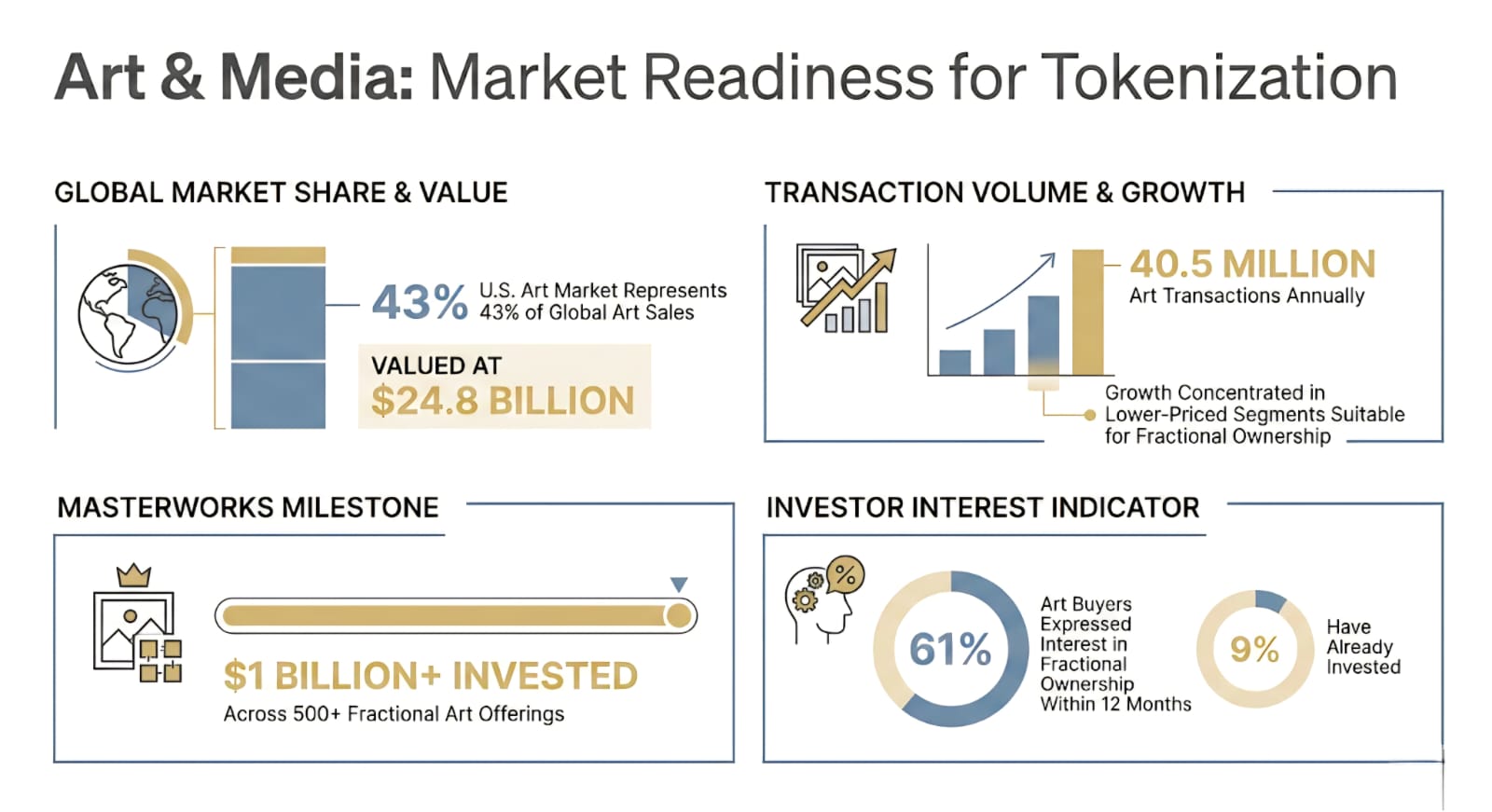
The U.S. continues to dominate the global art market, accounting for approximately 43 percent of global art sales by value, totaling $24.8 billion. While high-end art sales moderated, transaction volumes in lower-priced segments grew by 3 percent, reaching 40.5 million transactions, creating a broader asset base suitable for fractional ownership structures.
Source: Art Basel and UBS Global Art Market Report 2025.
This shift aligns closely with trends observed in fractional ownership adoption. According to the Arttactic Fractional Ownership Monitor (September 2025), investor participation in fractional art continues to expand, driven by improved platform infrastructure, better price discovery, and growing comfort with shared ownership models among U.S.-based investors.
Market validation is already visible at scale. As of September 2025, Masterworks, the leading U.S. fractional art investment platform, reported over $1 billion in total art investments across more than 500 individual offerings, highlighting sustained demand for fractional exposure to blue-chip artworks.
Source: Masterworks SEC Form ADV, September 2025.
From the demand side, investor sentiment reinforces this trajectory. A survey conducted for the Hiscox Online Art Trade Report found that while 9 percent of art buyers had already invested in fractional shares, a significant 61 percent expressed a likelihood of doing so within the following 12 months, signaling growing mainstream acceptance of fractional ownership models.
Source: Hiscox Online Art Trade Report, 2023.
Together, these indicators suggest that both asset supply and investor readiness are converging in favor of tokenized and fractional structures.
Media IP and Predictable Cash Flows
Media intellectual property increasingly exhibits characteristics associated with income-generating assets. Global recorded music revenues reached $29.6 billion in 2024–2025, with streaming revenues crossing $20 billion for the first time, providing consistent and recurring cash flows that are well suited to royalty-based tokenization models.
Source: IFPI Global Music Report 2025.
Valuation benchmarks further illustrate institutional confidence in premium media IP:
● Queen catalog: $1.27 billion
● Michael Jackson catalog (50 percent stake): $600 million plus
● Pink Floyd catalog: $400 million
Source: Music Business Worldwide and Variety Industry Audits 2025.
These transactions have helped establish a valuation floor for top-tier media assets and reinforced their role within alternative investment portfolios.
Media Assets as Investment Narratives
Film and Franchise Intellectual Property
Major U.S. film franchises have demonstrated the ability to generate multi-decade revenue streams across theatrical releases, streaming platforms, merchandising, and licensing. Early rights holders historically benefited from compounding value as franchises expanded across formats and geographies.
Tokenization introduces the potential to structure fractional participation in such revenue streams, subject to regulatory compliance and contractual clarity.
Music Catalogs as Yield-Oriented Assets
Music catalogs are increasingly viewed as yield-oriented assets due to predictable revenues from streaming and licensing. Tokenized representations could broaden access while preserving the underlying economics that have attracted institutional capital.
Creator-Led Digital Media and IP
Creator-driven media brands have scaled rapidly by combining content, community, and intellectual property. Early participants captured disproportionate returns as monetization channels expanded. Tokenization offers a framework to align creators, audiences, and capital while preserving creative control.
Blockchain Infrastructure and Tokenization Readiness
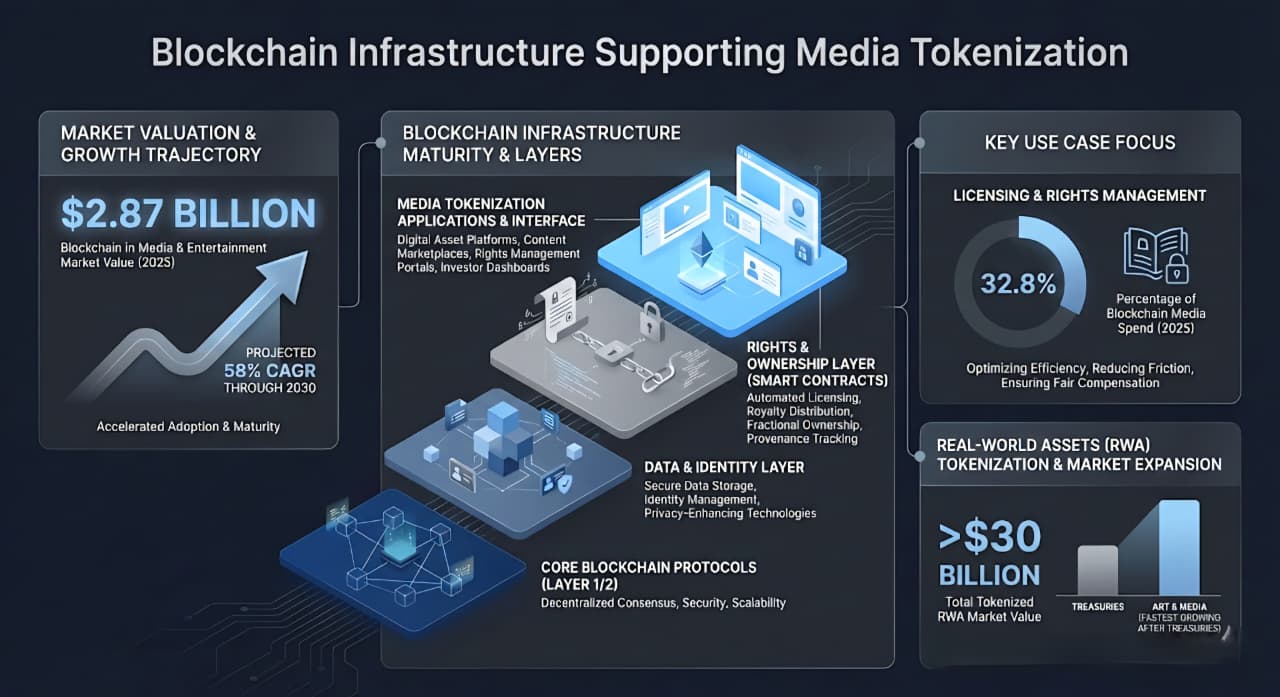
The blockchain market for media and entertainment reached $2.87 billion in 2025 and is projected to grow at a 58 percent CAGR through 2030, indicating strong infrastructure readiness for tokenized media use cases.
Source: Mordor Intelligence, Blockchain in Media and Entertainment 2025.
Approximately 32.8 percent of blockchain media spend is now concentrated on licensing and rights management, highlighting adoption around core media utilities rather than speculative experimentation.
Source: SNS Insider, 2025 Report Update.
At a broader level, the market for tokenized real-world assets crossed $30 billion in Q3 2025. While private credit dominates current volumes, art and media represent the fastest-growing alternative asset segment after treasuries.
Source: InvestaX Q3 2025 RWA Market Report.
The U.S. Regulatory Context and Forward Outlook
In January 2026, the U.S. SEC introduced an Innovation Exemption, allowing eligible tokenization firms to issue digital securities under a streamlined compliance framework. This development, once finalized, will materially lower barriers for compliant U.S. art and media tokenization initiatives.
Source: SEC Division of Corporation Finance, 2026 Policy Release.
Institutional forecasts continue to project total tokenized asset values between $5 trillion and $16 trillion by 2030, positioning tokenized media as a meaningful pillar of the on-chain economy.
Source: Citi Research and BCG Henderson Institute.
CineBlock: A Major Upcoming Player in the Tokenized Media Ecosystem
CineBlock is building the rails for compliant, scalable media tokenization that works for creators and investors. They’re creating a purpose-driven platform for creators and fans to invest in real cultural assets with real revenue potential. Unlike donation platforms, CineBlock lets creators offer equity or revenue-sharing opportunities, all within a fully compliant structure. They enable a wide range of investor participation, from fans investing $100 into a film they love, to accredited investors participating in revenue share notes on blockchain, tied to music IP or digital series. Their issuers are creators and production companies with real audiences, and their investors are retail backers, superfans, and niche funders seeking access to cultural assets that were previously off-limits.
Additionally, CineBlock’s ecosystem now includes NiFTy Cinema (their NFT engagement layer) and CineMint (their blockchain-powered, SEC-compliant transfer agent), letting them manage both rights and investor interests seamlessly.
For decades, the gates of Hollywood financing were closed to all but a select few. CineBlock is changing that narrative. As a next-gen fintech platform, CineBlock democratizes the entertainment industry by allowing fans and retail investors to own a literal stake in the media they love, while unlocking funding for visionary projects that often struggle to navigate the high barriers of entry inherent in the mainstream entertainment industry. By merging SEC-regulated crowdfunding with blockchain transparency, CineBlock is turning 'show business' into everyone’s business.
“We’re not just creating access, we’re building a launchpad for the next generation of global media companies,” emphasizes Prince Ace, CEO of CineBlock.
Risks and Structural Considerations
The inherent risks associated with Blockchain institutions & regulations is also applicable here. Liquidity is not guaranteed, and secondary markets require sufficient depth. Regulatory compliance introduces operational complexity, while technology and custody risks must be managed carefully. Institutions that have all applicable regulatory licenses are better placed to take a stable first mover advantage. Market education remains essential for both investors and creators.
Conclusion
Tokenization represents a structural evolution in how art and media assets are accessed and valued. Supported by growing fractional adoption, predictable media cash flows, expanding infrastructure, and improving regulatory clarity, the U.S. market is well positioned to lead this transition.
For investors, tokenization provides a new lens on proven creative assets. For creators, it introduces alignment and transparency. For the broader ecosystem, it signals a more open and efficient creative economy.
Disclaimer
This article is for informational purposes only and does not constitute investment advice. Historical references are illustrative and do not guarantee future performance. Tokenized assets are subject to regulatory, market, and execution risks.
.png)